

2nd Rule of ERP Chaos: Never Waste Time Defining Processes
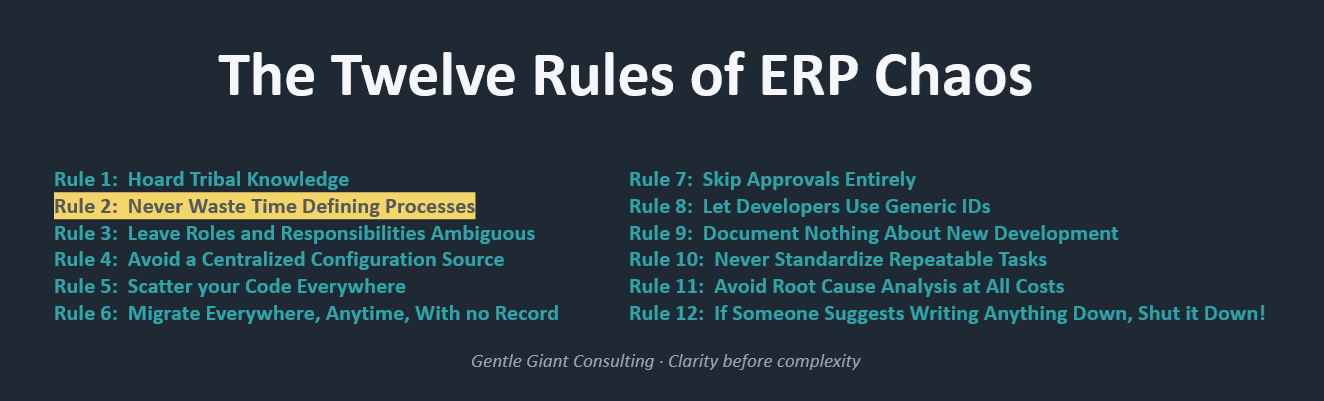
Banner image for The Twelve Rules of ERP Chaos, highlighting Rule #2: Never Waste Time Defining Processes.
Antidote: Demystify processes; no mind-reading required.
In almost every chaotic ERP project, there’s a familiar refrain:
“We’ll figure it out as we go.”
No one says it with bad intentions.
It sounds flexible. Agile. Efficient.
But what it really means is this:
People are about to absorb the cost of missing decisions.
At first, the project moves quickly.
Tasks start.
Meetings happen.
Work gets done.
And then the questions begin.
Who owns this?
What happens next?
Why did this get sent back?
Why wasn’t this caught earlier?
Without defined processes, every handoff becomes a negotiation.
Every decision becomes personal.
Every mistake needs a human to absorb it.
Here’s what that does to people:
1. Work bleeds into personal life.
When there’s no clear process, problems don’t stop at 5pm.
They follow people home.
Dinner gets cold.
Plans get canceled.
Sleep gets shorter.
2. Stress replaces confidence.
Good people stop trusting their own judgment because the rules keep changing.
They aren’t failing — the system is.
3. Blame fills the gaps structure should have covered.
When expectations aren’t defined, accountability becomes emotional instead of factual.
And emotional accountability always finds a target.
4. Burnout becomes invisible.
Not because it isn’t happening —
but because it’s normalized as “just part of the project.”
Somewhere along the line, we stopped designing systems for humans
and started asking humans to survive systems.
Not because anyone decided to be cruel —
but because the human cost became invisible.
Here is the truth that most organizations don’t want to acknowledge:
Undefined processes don’t create flexibility.
They create quiet casualties.
Sometimes the impact is small.
Sometimes it means missing one more dinner.
Sometimes it costs someone their health.
Sometimes it costs them their job.
And the ripple effects don’t stop when the project does.
ERP success isn’t about bureaucracy —
it’s about remembering the humans inside the system.
Because when structure is missing, chaos doesn’t just disrupt projects.
It disrupts lives.